Fay Arjomandi – mimik https://mimik.com YOUR ROI FOR AI Wed, 10 Jun 2026 17:24:33 +0000 en-US hourly 1 https://wordpress.org/?v=7.0 https://mimik.com/wp-content/uploads/2026/05/imi-Thumbnail-2-150x150.png Fay Arjomandi – mimik https://mimik.com 32 32 The Agents Are Already on the Laptop. Your IT and DevOps Stack Has to Reach Further. https://mimik.com/the-agents-are-already-on-the-laptop-your-it-and-devops-stack-has-to-reach-further/ Tue, 09 Jun 2026 22:18:22 +0000 https://mimik.com/?p=91677 Why the existing IT and DevOps stack does not reach the agent runtime, where the gap lives in your architecture, and what closes it without ripping out anything you built. An open-source AI agent crossed 134,000 GitHub stars before most procurement teams had heard its name. It is installed on employee laptops today. It reads […]

The post The Agents Are Already on the Laptop. Your IT and DevOps Stack Has to Reach Further. first appeared on mimik.

]]>
The Agents Are Already on the Laptop. Your IT and DevOps Stack Has to Reach Further.
Why the existing IT and DevOps stack does not reach the agent runtime, where the gap lives in your architecture, and what closes it without ripping out anything you built.

An open-source AI agent crossed 134,000 GitHub stars before most procurement teams had heard its name. It is installed on employee laptops today. It reads their email, drives their browser, executes shell commands, and runs continuously in the background. Your firewall does not see it. Your VPN does not protect against it. Your identity stack does not authenticate it. Your SIEM cannot describe what it does.

This is not a hypothetical from a Gartner deck. This is your current attack surface.

And it does not stop at the laptop. The same gap runs through every device the enterprise operates: phones, controllers, robots, vehicles, gateways, servers. The laptop is the first example because the laptop is the most visible. The architectural problem is the same on every endpoint.

The IT and DevOps stack inside every enterprise was built over a decade of patient investment. It enrolls devices, authenticates users, authorizes access, deploys applications, monitors traffic, and audits compliance. It is intact and it is necessary. It is also architecturally incomplete for the era that just arrived. The agents your employees are running today operate outside every control point your stack was designed to enforce, and they take real actions, against real systems, on real corporate data.

This post is for the leaders accountable for that gap: the CIO, the CISO, the CTO, Platform Engineering, DevOps, SRE, and the developers themselves. It names the stack you built, names what just arrived on top of it, names why current controls cannot reach the new layer, and shows where the gap closes. The path forward is not rip and replace. It is extend. And the extension has a specific structural shape.

The stack you built

Walk into the average enterprise IT and DevOps function today and you find a layered system that took ten years and a generation of vendor consolidation to assemble. Each layer governs a specific scope. Each layer has a specific reach.

At the network and identity edge: a perimeter you no longer trust (firewalls, VPN, ZTNA), an identity and access management plane that authenticates and authorizes users (Okta, Microsoft Entra, Ping), and SaaS access control (Netskope, Zscaler, CASB). At the endpoint and device: a fleet you manage by policy (Microsoft Intune, Jamf, Workspace ONE, Kandji), an endpoint protection platform that watches the binaries (CrowdStrike, SentinelOne, Microsoft Defender), and an asset inventory that knows what’s deployed where. At the workload and data: SIEM and SOAR that ingest the telemetry (Splunk, Sentinel, Chronicle), DLP that classifies and gates data movement, and observability platforms that watch the services (Datadog, Splunk, New Relic). In the engineering pipeline: source control, CI/CD, secrets management, artifact registries, change management, and incident response.

This stack covers four things, mostly well: users (who they are, what they can access), devices (whether they are managed, encrypted, and compliant), networks (what flows where), and applications (deployed by your DevOps pipelines into your environments).

It does not cover the actor that just arrived: the autonomous software agent that runs on the employee’s machine, in the employee’s session, against your systems and your data.

What just arrived

The shift is already in production. Not in a pilot, not in next year’s plan, but in the wild. Three categories of software are the new actors.

The first is the autonomous coding agent. Claude Code, OpenClaw, Cline, Aider, and a growing set of open-source variants run in the developer’s terminal or editor. They write code, execute it, fix the errors, commit, push, and iterate. They are continuous: not a single chat session but a long-lived process with persistent state. They have shell access. They have file system access. They use the developer’s credentials. They make commits in the developer’s name.

The second is the computer-use agent. Software that takes screenshots of the user’s desktop, decides where to click, types into form fields, opens browsers, sends email, reads documents. It does what the user does, only it does it autonomously, often unattended, and at machine speed.

The third is the in-application agent assistant. The “ask AI” button inside Notion, the Copilot inside the IDE, the AI agent in the help desk tool, the agent embedded in the data analytics platform. Each one is small. Together they multiply. Each one runs with permissions the user granted it, often once, often broadly.

None of these were procured. None were deployed by IT. None show up in your CMDB. None of them are governed by the policies your stack enforces because the stack does not see them as actors. It sees, at best, a process running under a user, on a managed device, making outbound HTTPS calls. The process is approved. The device is compliant. The traffic is encrypted. To the stack, everything looks normal. The actor inside is invisible.

The laptop is the most visible example because it sits in the developer’s hands and the SOC’s nightmares. The same actor class is appearing across the enterprise endpoint estate. Mobile devices run AI assistants that read messages, schedule meetings, and execute on behalf of the user. Industrial controllers in manufacturing plants run inference at the edge and increasingly act autonomously on the production line. Robots in warehouses, smart cameras in retail, in-vehicle compute in fleet operations, and embedded systems in smart buildings all run agents that take real actions against enterprise systems, against enterprise data, with the same governance gap. The IT and DevOps team’s responsibility does not end at the laptop. The stack has to reach every device.

Agents enter like people, not like applications

Here is the structural shift the existing stack was not designed for. Software arrived for the past three decades as applications. Applications are containers. You deploy them. You patch them. You inventory them. You monitor their processes and their network. You apply policy at the network and identity boundaries around them. The application itself is largely passive until invoked, and when invoked, what it does is bounded by what its code can do.

An agent is not an application. An agent is an actor that arrived inside the building like a person.

When a new employee starts, you do not just check whether their laptop is compliant. You issue them an identity. You grant them authorization scoped to their role. You define what they can access in which systems. You log what they do. You can revoke their access. They have an HR record, a manager, a department, a project assignment. They have a floor pass that tells the building what doors open for them and which do not. They have a digital floor pass that tells the systems what data they can see and what actions they can take.

An agent now needs all of that, and the stack you built does not issue any of it for them.

An agent is a software actor that needs an identity distinct from the user, authority scoped to a task, observability tied to its identity, and a lifecycle that ends when its purpose ends. None of these are properties of an installed application. All of these are properties of a person.

The IT and DevOps stack already knows how to do these things. It does them for people. It does them for service accounts. It does not do them for autonomous agents running inside the user’s session.

Why current controls cannot reach

Each layer of the existing stack has a specific reach. None of them reach where the agent executes.

Network and perimeter governs flows in and out. The agent runs inside the trusted boundary. Its traffic looks like the user’s traffic. The agent is a process on a known machine; the perimeter cannot tell it is not the user.

Identity and IAM governs who the user is and what the user can access. The agent borrows the user’s identity. There is no distinct agent principal in your IDP. There is no scoped credential for the agent. There is no way to revoke the agent without revoking the user.

Endpoint protection (EDR) governs binaries on the device. The agent is an approved binary. The signatures are clean. The runtime telemetry shows a process under a user. EDR confirms the binary is fine and reports the device as healthy. The actions the agent takes against your systems are not in scope.

SaaS access and CASB governs the SaaS connections users make. The agent makes those connections under the user’s authentication. The CASB sees the SaaS traffic but cannot distinguish the agent from the user.

SIEM and observability govern ingest telemetry that already lacks an agent identity. There is no event class for “agent X took action Y in context Z.” The SIEM gets a process trace, not a semantic record.

CI/CD and DevOps pipelines govern code you wrote and deployed. The agent is not your code. You did not deploy it through your pipelines. There is no dev/staging/prod for the agent. There is no rollback.

Every layer is doing exactly what it was designed to do. Every layer is intact. The actor is the wrong unit of management. The stack was designed for users, devices, applications, and code. The agent is none of those.

Device management reaches the device. It does not reach the agent.

One layer of the stack already reaches the laptop, the desktop, and the phone. It is the device and remote management layer, and any IT leader will reasonably ask whether it already covers this. It does not, and the reason is precise.

Device and remote management is the one control plane built to operate on the endpoint itself. MDM and UEM platforms such as Microsoft Intune, Jamf, Omnissa Workspace ONE, and Kandji enroll the device, enforce its operating system configuration and compliance, deploy and inventory the approved applications, and tie all of it to the user and the device posture. Where the rest of the stack stops at the network or the cloud, this is the layer that actually lands on the machine.

But its unit of management is the device and the user, and its model of software is the installed application. It can push an agent onto the laptop as a managed app, confirm the device is encrypted and compliant, and report the fleet as healthy. What it cannot do is treat the agent as an actor. There is no agent identity distinct from the user. There is no authority scoped to a single agent and a single task. There is no semantic record of what the agent did, against what, and on whose behalf. There is no quota, no rate limit, and no kill switch at the granularity of the agent.

To the management console, a compliant laptop running an approved binary is a solved problem, even while that binary autonomously takes thousands of actions under the employee’s identity.

The channel this layer holds to the device, waking it to sync, pulling compliance state, and pushing configuration, is a channel to the operating system and its managed apps. The agent runs above that channel, inside the user’s session, and stays invisible to it. This is the same gap that runs through the rest of the stack, now appearing in the layer closest to the metal. Device management governs the container the agent runs in. It does not govern the agent.

The structural answer is not to replace device management. It is necessary, and it stays. The answer is a new management layer that sits on top of it, takes the managed and compliant device as its trusted foundation, and governs the agents running on that device as first-class actors.

The Layering

The new layer does not duplicate what device management does, and it does not ask you to rip it out. It consumes the managed device as a foundation, the same way container orchestration consumes the host it runs on, and adds the one thing the layer beneath it was never designed to provide: governance of the agent as an actor, not the device as a box. The device stays managed. The agent finally becomes managed too.

The new questions IT and DevOps have to answer

If the existing stack does not reach the runtime where agents execute, then the questions are now structurally different. Eight of them, drawn from the operational disciplines IT and DevOps already apply to everything else they manage.

The new questions IT and DevOps have to answer

Install policy

Which agents are sanctioned, which are tolerated, which are blocked. What sources are trusted. What versions and hashes are pinned. How are updates governed.

Authentication

Every agent on the device needs its own identity, distinct from the user’s. Provisioned, rotated, and revocable, with credentials that never live unencrypted on disk.

Context-aware authorization

The agent’s authority must be granted at the moment of action, scoped to the task, time-bounded, and tied to the policy class the agent belongs to. The floor-pass model, applied to software actors.

Runtime observability

Every action every agent takes, on every device, recorded as a first-class semantic event, not a process trace. Tied to the agent’s identity. Reviewable. Correlatable across devices and agents.

Quota and rate management

How much can a given agent consume in API calls, in compute, in tokens, in time. Per agent, per user, per device, per environment.

Staged rollout

Agents need their own dev, staging, production lifecycle. The same gates you apply to code apply to agent deployments and updates.

Kill switch and exit

When the project ends, when the employee leaves, when an agent misbehaves, you need to revoke its identity, terminate its sessions, and prove it stopped.

Tenancy and isolation

Personal use of an agent should not bleed into enterprise use of the same agent on the same device. The boundary has to be real and enforced at the runtime.

These are not aspirational. These are the same disciplines you already apply to users (identity, role, audit, offboarding), to services (deployment, observability, rate limiting, kill switch), and to data (classification, access policy, lineage). The agent is a new unit of management, and the operational pattern is the one you already know. It just has to be applied where the agent actually executes.

There is a ninth question behind the eight. Every question above treats the agent as a single actor working against enterprise systems. That is where governance starts, and it is not where agentic systems stop. The moment two agents collaborate, on the same device or across the device estate, the governance problem becomes an interaction problem: who directs the work, how peers maintain a shared picture of identity and trust, how an event on one device triggers action on another. Our CTO, Michel Burger, wrote about the three modes of agent interaction, orchestration, coordination, and choreography, and why an Agentix-Native system runs on all three at every layer. The two questions compose. Governance defines what one agent may do. The interaction modes define how many agents act together. The runtime has to enforce policy in all three modes, not just the first.

Where mimOE sits, and why there

The shape of the answer is now visible. There is a new layer of the IT and DevOps stack. It sits at the runtime where the agent executes. It treats the agent as a first-class actor. It exposes agent identity upward into IAM, agent telemetry upward into SIEM, agent lifecycle upward into ITSM. It consumes the managed device as its foundation. It does not duplicate any layer beneath it.

mimik built that layer. It is called mimOE, the Agentix Operating Engine. The architectural placement is deliberate, and the reasoning matters more than the assertion.

Why the runtime, not the perimeter

The agent’s actions originate at the runtime, on the device. Everything downstream of that is consequence. If governance enters only after the agent’s request leaves the device, the policy decision is being made by a layer that no longer has full context. The user’s identity is on the wire but the agent’s identity is not. The action’s intent is implicit but never declared. The policy enforcement point ends up trying to reconstruct what should have been governed at the source. Perimeter retrofits cannot reach this. They are not where the agent decides.

Why a new layer, not a feature of an existing one

The agent layer is structurally different from every other layer of the stack, and that difference makes it impossible to fold into any of them. IAM governs users and service accounts and the agent is neither. EDR governs binaries on the device and the agent’s behavior is not a property of its binary. CASB governs SaaS access and the agent operates inside user sessions across many SaaS and non-SaaS targets. MDM governs the device as a managed unit and the agent runs above the OS. The agent is its own unit of management. Like every prior unit of management in the history of enterprise IT (user, device, application, service), it needs its own layer.

Why on top of the device, not in the cloud

The cloud-resident option exists. There are agent runtimes that operate from a control plane in the cloud and reach down to the device through APIs or proxies. The structural problem with that placement is the same one the rest of the stack has. By the time the agent’s intent reaches the cloud, the moment of action has already passed. The cloud runtime can govern the next request but not the current one. It cannot enforce policy at the moment of action because the moment has elapsed by the time the cloud sees it. And the cloud runtime cannot operate when the device is offline, partially connected, or operating in a sovereign network the cloud does not enter. The runtime layer for agents has to live where the agents do, which is on the device.

The continuum claim

The same operating engine extends beyond the laptop. mimOE runs on every class of enterprise endpoint: laptops and desktops where developers and knowledge workers run their agents, mobile devices where in-application agents operate, industrial controllers and embedded systems where agentic inference drives production, robots in operations and logistics, vehicles and other Physical AI form factors, edge gateways at the boundary, on-premises servers, and across the data center. The agent layer is unified across the entire device-first continuum. An agent that starts a task on the laptop and offloads compute to a gateway, or that runs autonomously on a robot and reports to an enterprise back office, runs through the same runtime, the same identity model, the same observability fabric. The IT and DevOps team operates one control plane across the continuum, not eight different governance regimes for different device classes.

The three interaction modes from the ninth question show up here in concrete form. The offload from the laptop to the gateway is choreography: two peers negotiating in the moment, with no central controller in the loop. The staged rollout described earlier is orchestration: deliberate, top-down, gated. The propagation of identity and trust across the mesh is coordination: peers maintaining a shared operational picture. All three modes run through the same runtime and answer to the same policy, on every device class.

THE ARCHITECTURAL PLACEMENT

mimOE is the agent runtime layer of the enterprise control plane. It sits at the runtime on the device, consumes the managed and compliant device as its foundation, exposes agent identity and observability upward to the rest of the IT and DevOps stack, and extends across the device-first continuum. It is the layer the existing stack does not have, in the place the existing stack cannot reach.

How mimOE closes each of the eight gaps

The eight capabilities the agent layer requires are not abstractions. They are the explicit operational discipline the agent runtime has to deliver. The table below maps each capability to how mimOE provides it.

mimOE Capability Table
Capability How mimOE delivers it
Install policy

Manifest-driven agent registry. Each agent declares its capabilities, permissions, dependencies, and signing in a signed manifest. IT defines which manifests are sanctioned at the policy layer. Sanctioned, tolerated, blocked are policy states the agent runtime enforces at install and at every invocation.

Authentication

Per-agent identity federated through the enterprise IDP. Each agent receives its own principal, distinct from the user. Credentials are short-lived, rotated, and never live unencrypted on disk. Identity binds the agent to the user, the project, and the policy class, and revoking any one of those revokes the agent.

Context-aware authorization

Policy enforced at the agent’s API boundary, in the moment of action. The policy is context-aware: scoped to the task, time-bounded, evaluated against the data class involved and the policy class the agent belongs to. mimOE evaluates and enforces in-process at the runtime, before the action leaves the device.

Runtime observability

Every agent action emitted as a structured semantic event: agent identity, declared intent, target, parameters, outcome, downstream effects. Events stream to the enterprise SIEM in standard formats (CEF, ECS, OCSF, OpenTelemetry). The SOC sees the agent as an actor, not a process.

Quota and rate management

Quota and rate limits enforced at the agent identity layer at the runtime. Per agent, per user, per device, per environment, per data class. Limits are pre-flight (the agent learns before the action), not post-flight (the cloud bill arrives after the action).

Staged rollout

Agents flow through dev, staging, and production gates that mirror your CI/CD pipelines. Same approvals, same versioning, same rollback. mimOE integrates with the pipeline tools you already operate (GitHub Actions, GitLab, ArgoCD) and the change-management tools you already audit through (ServiceNow, Jira).

Kill switch and exit

Agent identity is revocable at the runtime in real time. Revocation terminates active sessions, prevents new ones, and emits a structured exit event. Revocation can fire from IAM lifecycle events (Okta or Entra offboarding), from the SIEM (detected misbehavior), or manually. The audit trail proves the agent stopped. And in a mesh, revocation propagates: when the revoked agent has delegated work to peers, the runtime cancels the delegated tasks across the mesh and the exit event records the full delegation chain. Proving one agent stopped is easy. Proving its delegations stopped is the part a cloud control plane cannot do, and the part the runtime layer does.

Tenancy and isolation

Personal and enterprise contexts maintained as separate operational tenants on the same device. The agent operating in personal context cannot reach enterprise data or credentials, and vice versa. The boundary is enforced at the runtime, not by user discipline or by data-class policy alone.

None of these capabilities replace anything in your existing stack. Every one of them produces an event, an identity, or a policy decision that the existing stack consumes. The agent layer extends the operating model the enterprise already runs. It does not introduce a parallel one.

What mimOE composes with

The agent layer cannot be a silo. Every IT and DevOps team operates a portfolio of tools the agent runtime has to participate in, not replace. mimOE composes with each layer of the existing stack through standard interfaces and explicit integration points.

mimOE Integrations Table
Identity and Access Management Okta, Microsoft Entra ID, Ping Identity

mimOE federates per-agent identity through the enterprise IDP via OIDC and SAML. SCIM-based provisioning ties agent lifecycle to the user lifecycle: when the user is deactivated, every agent attached to that user is automatically revoked. The IDP becomes the source of truth for agent identity, the same way it is for human identity.

SIEM and security analytics Splunk, Microsoft Sentinel, Chronicle, Elastic

mimOE exports agent events in CEF, ECS, and OCSF formats with structured fields for agent identity, intent, target, and outcome. SOC analysts query agent activity in the same dashboards they already use for endpoint and identity telemetry. No new console required.

Endpoint protection (EDR) CrowdStrike, SentinelOne, Microsoft Defender

mimOE coexists with EDR on the same device. EDR observes the agent’s binary as a process and validates its integrity. mimOE observes the agent’s behavior as an actor and governs its actions. The two answer different questions. EDR confirms the binary is safe to run. mimOE controls what the binary is allowed to do.

Device and unified endpoint management Intune, Jamf, Workspace ONE, Kandji

mimOE runs on the managed device. The device stays under MDM compliance, encryption, OS configuration, and inventory. mimOE adds the agent governance layer above the device layer. Each tool keeps its scope.

CI/CD and engineering pipelines GitHub Actions, GitLab, ArgoCD, Jenkins

mimOE provides agent deployment gates that mirror code deployment gates. The same dev/staging/prod environments, the same approval workflows, the same rollback. Agents move through the same pipelines and the same governance as the code your engineers ship.

Observability and APM Datadog, Splunk, New Relic, Honeycomb, Dynatrace

mimOE exports agent traces and metrics in OpenTelemetry, Prometheus, and vendor-native formats. SRE and platform engineering teams see agent behavior in the same dashboards they use for the rest of production. Agent SLOs and incident response folds into the existing on-call practice.

ITSM and IT operations ServiceNow, Jira Service Management, BMC Helix

Agent lifecycle events (registration, deployment, revocation, incident) integrate into the enterprise ITSM workflow. Tickets generate. Approvals route. Audit trails persist. Agent operations follows the change-management discipline IT already practices.

FinOps and cost attribution Apptio, CloudHealth, Vantage, AWS Cost Explorer

mimOE attributes agent compute, network, and inference cost per agent identity, per user, per project, per business unit. Finance sees agent cost the same way they see cloud cost. Chargeback and showback work for agents the way they work for services.

EXTEND, DO NOT REPLACE

Every tool in your IT and DevOps stack was a deliberate decision. mimOE is not a request to revisit those decisions. It is a request to add the one layer that, when you made every prior decision, did not yet need to exist. The agent layer composes with what you operate. It governs the actor your stack does not see, and exposes that governance to the rest of your stack through the interfaces you already consume.

Flexibility with control

The temptation, faced with an unfamiliar layer of software acting on enterprise systems, is to block it. To declare the agent tools off-limits, to scan for them on managed devices, to mandate that productivity flows only through sanctioned platforms.

That stance loses both ways. The agents stay productive enough that employees will run them anyway, just outside the visibility of the team that tried to block them. The enterprise gives up the productivity gains it could have governed. The same agents that could be operating with identity, scoped authority, and observability operate without any of it. The team that wanted control ends up with less.

The path forward is the path the enterprise already knows from a generation of IT and DevOps practice. Let the productive thing be productive. Make it visible. Make it governed. Make it part of the stack the enterprise already operates. The agent layer makes that possible. It is the same operating model the enterprise has run for users, devices, applications, and code. It just has to be applied where the agent actually executes, with the right unit of management at the right layer.

The agentic AI era will not be defined by which company has the best model or the fastest chip. It will be defined by which enterprises operate that capability with the same discipline they apply to everything else in production. The architecture for that exists. The layer the existing stack was missing now has a name and a place. The control plane reaches the runtime. The agent finally becomes managed.

About mimik and mimOE

The Agentix Operating Engine, built for the runtime where the agent executes.

mimik is an Agentix-Native company and a pioneer in Device-First Continuum AI and Compute. mimOE is the Agentix Operating Engine that operates as a new layer of the enterprise control plane: on the device, across the continuum, composing with the IT and DevOps stack the enterprise already runs.

The post The Agents Are Already on the Laptop. Your IT and DevOps Stack Has to Reach Further. first appeared on mimik.

]]>
Sovereignty in Execution Goes Beyond Data Residency https://mimik.com/sovereignty-in-execution-goes-beyond-data-residency/ Thu, 19 Mar 2026 17:44:36 +0000 https://mimik.com/?p=90744 Agentix-Native: A Fundamentally Different Kind of System The applications that defined the last decade of computing were static and siloed. Cloud-first architecture was the natural design choice for that world. The device was a display. The cloud was the brain. Agentic systems are different in nature, not just in degree. Agents must have autonomy in […]

The post Sovereignty in Execution Goes Beyond Data Residency first appeared on mimik.

]]>
Agentix-Native: A Fundamentally Different Kind of System

The applications that defined the last decade of computing were static and siloed. Cloud-first architecture was the natural design choice for that world. The device was a display. The cloud was the brain.

Agentic systems are different in nature, not just in degree. Agents must have autonomy in execution. They must run on devices, at the edge, on premises, and in the cloud simultaneously. They must be able to discover each other dynamically, make decisions in real time, and act directly on data at the point where it is generated. Forcing this model through a cloud-first architecture introduces latency, dependency, and sovereignty gaps that simply did not exist in the static app world.

Yet today, the conversation about sovereign AI is still using the vocabulary and mental model of that older world. In a world where agents think, decide, and act autonomously at the point where data is born, data residency alone does not constitute sovereignty. It is simply the address on the building.

What Sovereignty Actually Means

Sovereignty is the full right and power to govern oneself, make decisions, take action, and persist under one’s own authority, where permission is self-defined and self-governed at the point of execution based on sovereign policies. Four elements must be present simultaneously at the point of execution: authority, control, continuity, and minimum intermediaries on the data path. Remove any one of them and what remains is not sovereignty. It is managed dependence.

Think about how you operate across the full spectrum of your daily activities. In a board meeting you communicate, present, and carry yourself differently than you do with a colleague over lunch, or on a client call, or in a personal conversation. You shift between these contexts fluidly, in real time, sometimes managing several simultaneously. You do not route these decisions through a central authority. You carry your context, your authority, and your boundaries with you and execute instinctively at the point of each interaction. That is sovereignty in execution. Agentix-native systems must be designed to mimic exactly this behavior, deliberately, at every layer, and at machine speed.

Every intermediary on the path between a decision and its execution is a point where sovereignty is conditionally suspended. Any intermediary is a dependency. A chain of intermediaries is a chain of vulnerabilities. This is the condition that current AI architectures routinely violate, including those being marketed as sovereign. The lack of sovereignty in execution is one of the primary reasons AI adoption at scale remains slower than the market expects.

The Five Dimensions of Sovereignty

1. Data Sovereignty: Where Data Governance Starts

Location alone does not tell you who opened the file, who copied it, or who made a decision based on it. It answers one question and leaves four others entirely open.

This means: the agent must be able to process, structure, and enrich data at the point where it is generated, whether on a sensor, a camera, or an industrial machine, and route each scope to the appropriate destinations based on storage and sovereignty policy executed at the source.

2. Compute Sovereignty: Where the Thinking Happens

An AI system that stores data locally but executes inference in an external cloud controls only where the paperwork is filed when the answer comes back. The data has an address. The thinking does not.

This means: the agent must have the autonomy to execute inference at the point of action, within its runtime context and sovereignty policy, without the necessity of a round trip to a remote model or cloud service.

3. Coordination Sovereignty: Who Collaborates and on What Terms

Collaboration is contextual, permission-driven, and scoped to relevance. It must happen directly between the parties who need to work together without routing every exchange through a single gatekeeper who holds everything.

This means: the agent must be able to determine and exercise its authority to collaborate with other agents within its runtime context, dynamically at the point of interaction. This enables autonomous collaboration dynamically choreographed within the bounds of security, access and authorization scope to execute in full operational sovereignty.

4. Operational Sovereignty: The Right to Continue Acting

When the person at the top of the chain is unreachable, the team does not shut down. They operate within their last known mandate until contact is restored. When an AI system loses its cloud connection, it stops. That is not a resilience problem. It is a sovereignty problem.

This means: the agent must be able to determine and exercise its authority to collaborate with other agents within its runtime context, dynamically at the point of interaction, carrying the ontological context it needs to act without reaching back to a central system for meaning. This enables autonomous collaboration dynamically choreographed within the bounds of security, access and authorization scope to execute in full operational sovereignty.

5. Outcome Sovereignty: Who Owns the Result

If the signature on a deliverable must happen on someone else’s platform, using someone else’s ledger, the outcome has a dependency built into it regardless of how the work leading up to it was conducted.

This means: the agent must be able to settle the results of its actions, record outcomes, and maintain an audit trail with full observability of every execution, operation, and interaction from the source, within its own runtime environment, under the organization’s full control.

Embedded Sovereignty: Where all 5 Dimensions Converge

Embedded Sovereignty is a dedicated execution layer present at the point of origin, delivered in three forms:

as part of an agentix solution or application as Sovereignty-in-solution, pre-integrated on a device as Sovereignty-on-Device, or embedded at the chip level as Sovereignty-on-Chip. The closer it is to the chip, the faster the path to production for the entire ecosystem: device vendors, developers, and enterprises alike. Without it, each of the five dimensions requires a separate implementation effort. Data residency requires infrastructure decisions. Compute sovereignty requires on-device inference capability. Coordination sovereignty requires a distributed agent runtime. Operational sovereignty requires offline-first architecture. Outcome sovereignty requires on-device settlement capability.

Addressed individually, each is a project. Addressed sequentially, they compound into years of engineering debt. From the moment a system with Embedded Sovereignty powers on, connected or not, all five dimensions are already satisfied. That is the difference between sovereignty as a destination and sovereignty as a design principle. That design principle is also what distinguishes Embedded Sovereignty from an operating system. An operating system is passive by design. It manages resources and waits for instructions. Agents do not wait. They collaborate with other agents in dynamic workflows. Operating based on the principles of follow, observe, respond, and learn, they discover, decide, coordinate, and act proactively based on context, authority, and sovereign policy. What they require is a Sovereign Execution System, one that is device-first by design, as autonomous and context-aware as the agents running within it, and capable of operating across the full compute continuum from the chip to the cloud.

For the enterprise, Embedded Sovereignty is not an infrastructure decision. It is the difference between AI that operates under your authority and AI that operates under someone else’s.

Without it, every jurisdiction becomes a re-engineering project, every cloud dependency becomes a point of operational risk, and every sovereignty gap accumulates into compliance and liability exposure. With it, the organization deploys once, governs from the point of execution, and retains full control across every context in which its agents operate. For device vendors and OEMs, every device that ships becomes a production-ready sovereign node out of the box. For developers, the execution environment travels with the agent across any hardware, any OS, and any connectivity state.

This is not a future capability. mimik delivers Embedded Sovereignty as a production-ready platform, available today at the solution, device, and chip level.

The post Sovereignty in Execution Goes Beyond Data Residency first appeared on mimik.

]]>
Harnessing the Power of Hybrid Edge Cloud: Revolutionizing App Development with mimik https://mimik.com/harnessing-the-power-of-hybrid-edge-cloud-revolutionizing-app-development-with-mimik/ Wed, 19 Jul 2023 17:00:00 +0000 https://mimik.com/?p=81264 Introduction Recently, I have been receiving numerous inquiries from individuals who are intrigued by the concept of Hybrid Edge Cloud (HEC). They are keen to understand its practical applications and which types of applications can benefit the most from this innovative approach. In response to their curiosity, I have decided to shed some light on […]

The post Harnessing the Power of Hybrid Edge Cloud: Revolutionizing App Development with mimik first appeared on mimik.

]]>
Introduction

Recently, I have been receiving numerous inquiries from individuals who are intrigued by the concept of Hybrid Edge Cloud (HEC). They are keen to understand its practical applications and which types of applications can benefit the most from this innovative approach. In response to their curiosity, I have decided to shed some light on the versatility of HEC as a modern approach for cloud-native applications. While it is applicable to all applications, I will also highlight specific use cases that exemplify its potential and advantages.

In today’s rapidly evolving digital landscape, app developers are constantly seeking ways to optimize their applications. The HEC from mimik provides a revolutionary solution that combines the power of edge computing and cloud computing. It offers a host of benefits such as enhanced performance, reduced latency, data privacy, scalability, and cost and energy efficiency. This powerful combination has piqued the interest of developers across various industries.

In this blog, I aim to demystify the concept of HEC and explain why it is a modern approach suitable for all cloud-native applications. Additionally, I will delve into specific use cases that highlight the remarkable potential of HEC, showcasing its transformative impact in real-world scenarios.

Let’s dive in and explore how HEC can revolutionize app development, optimize performance, and unlock new possibilities for innovation.

Understanding Hybrid Edge Cloud (HEC)

HEC represents the convergence of edge computing and cloud computing, combining the best of both worlds. With mimik’s platform, developers can leverage the power of local smart devices as cloud servers capable of deploying microservices and the central cloud to enhance their applications’ performance, scalability, and flexibility.

Seamless App Integration

One of the key advantages of mimik’s HEC platform is its seamless integration with existing app development processes. Regardless of the programming languages or frameworks you prefer, mimik supports a wide range of options, enabling you to build applications using the tools you’re already familiar with. Furthermore, the platform is built fully at the application level and works across various operating systems and device types, ensuring your applications can run seamlessly on different platforms.

Enhanced Performance and Latency Reduction

Latency can make or break user experiences, especially in applications that require real-time interactions. HEC can drastically reduce latency by minimizing network round trips while leveraging the computing resources on smart devices. This approach results in faster response times and improved user experiences. Whether it’s a video streaming application, a real-time multiplayer game, or an IoT-based solution, the HEC ensures optimal performance for your applications.

Data Privacy and Security

In an era of increasing data breaches and privacy concerns, protecting user data is paramount. With HEC, app developers can keep sensitive data on local smart devices, reducing the risk of unauthorized access or data breaches. By minimizing the need to transfer sensitive information to the cloud, developers can maintain greater control over data privacy and security. mimik’s platform also employs robust trustless security measures and encryption protocols, further safeguarding user data.

Scalability and Cost Efficiency

Scaling applications based on demand is a crucial aspect of app development. HEC enables developers to scale their applications effortlessly. By distributing computing resources across a network of smart devices, developers can handle increased workloads without relying solely on dedicated cloud infrastructure. This results in improved scalability and cost efficiency, as developers can optimize resource utilization and reduce reliance on extensive cloud resources.

Real-World Use Cases

HEC has found significant applications in various industries, showcasing its remarkable capabilities. Let’s explore two specific examples: automotive and industrial IoT. These use cases demonstrate the transformative impact of HEC.

Software-defined vehicles (SDVs) offer the advantage of adaptability and improvement through software updates, like smartphones. With separate hardware and software components, SDVs can harness technological advancements like hyper-personalization, autonomous driving, and safety features without costly hardware upgrades. This flexibility ensures up-to-date functionality, enhanced user experiences, and prolonged vehicle lifespan.

When combined with mimik’s HEC, SDVs gain two additional benefits. First, HEC reduces network dependency for SDVs. Traditional SDVs are often susceptible to network availability issues, which can hinder their operations. By leveraging mimik’s HEC, vehicle functions, exposed as function-as-a-service, can be meshed with various other functions at the edge of the network. This reduces reliance on a centralized network infrastructure, making SDVs more resilient to network conditions and enhancing their overall operational reliability.

Second, HEC enables hyper-personalization at the local level. SDVs have the capability to interact with multiple systems and devices, such as infotainment units and Telematics Control Units (TCUs) inside the vehicle, passenger smartphones, and smart city infrastructure. By leveraging HEC, SDVs seamlessly integrate and communicate with these vertically incompatible systems, facilitating a high degree of personalization for each user. This empowers SDVs to offer tailored experiences based on individual context and preferences, whether it’s adjusting the cabin environment, entertainment options, or personalized assistance features. HEC’s edge computing capabilities enable efficient and localized data processing, enabling SDVs to deliver real-time personalized experiences without heavy reliance on centralized cloud-based services.

Similarly, in industrial IoT applications, such as those found in the energy and mining sectors, connectivity to the cloud can be poor, expensive, or nonexistent. Energy and mining companies can leverage mimik’s HEC to overcome these challenges. By deploying edge endpoints and utilizing local computing resources, IoT devices can process and analyze data on-site, enabling real-time monitoring, predictive maintenance, and optimization of critical processes. This empowers companies to make timely decisions, improve operational efficiency, and reduce costs associated with transferring massive amounts of data to the cloud.

Conclusion

HEC empowers app developers with enhanced performance, reduced latency, data privacy, scalability, and cost efficiency. It finds practical applications in various industries, showcasing its remarkable capabilities. For the automotive industry, HEC empowers software-defined vehicles (SDVs) to function as local services, seamlessly integrating with local systems even in environments with limited network connectivity. In the energy and mining sectors, where cloud connectivity is often poor or nonexistent, mimik’s platform allows for on-site data processing, improving real-time monitoring and decision-making while keeping mission critical data private and secure.

These examples highlight the transformative impact of HEC, but it’s important to recognize that its benefits extend to a wide range of cloud-native applications. Whether it’s healthcare, retail, smart homes, or any other domain, HEC offers a pragmatic solution that enhances performance, reduces latency, ensures data privacy, enables scalability, and optimizes cost and energy efficiency.

By seamlessly integrating edge computing and cloud computing, mimik’s platform unlocks new possibilities for innovation, providing developers with the tools to create cutting-edge applications that meet the evolving needs of consumers and enterprises. It bridges the gap between local smart devices and the cloud, allowing for distributed computing and improved user experiences.

The post Harnessing the Power of Hybrid Edge Cloud: Revolutionizing App Development with mimik first appeared on mimik.

]]>
The Journey to Autonomy: Unleashing the Power Within https://mimik.com/the-journey-to-autonomy-unleashing-the-power-within/ Sun, 28 May 2023 21:45:00 +0000 https://mimik.com/?p=81259 Once upon a time, there lived a young and curious infant named Alex. Alex was a bright and adventurous boy, always eager to explore and learn from the world around him. As he grew older, his physical abilities and understanding of the world deepened. In his early years, Alex relied on simple means to fulfill […]

The post The Journey to Autonomy: Unleashing the Power Within first appeared on mimik.

]]>
Once upon a time, there lived a young and curious infant named Alex. Alex was a bright and adventurous boy, always eager to explore and learn from the world around him. As he grew older, his physical abilities and understanding of the world deepened.

In his early years, Alex relied on simple means to fulfill his needs. When hungry, he would cry out for attention, signaling his desire for nourishment. Like any caring parents, his mom and dad would respond by preparing a meal for him. But as Alex continued to learn and develop, something extraordinary happened — he started to become more and more autonomous.

No longer needing to cry for every meal, Alex’s mind evolved into a complex system of interconnected thoughts and capabilities. With a simple thought, he could decide whether to cook a meal at home using his own skills or venture out to discover the diverse culinary offerings of the city. He had become a self-sufficient entity, relying on his own intelligence and resources to navigate the world.

In this captivating analogy, Alex’s journey from infancy to autonomy mirrors the evolution our digital world needs. Today, internet applications are like Alex in his infancy, reliant on external resources and centralized cloud architecture for even the most basic tasks. However, for true autonomy to flourish, a transformation is required — a transition from dependence on centralized infrastructure to leveraging the local resources of the devices they run on, just like Alex relies on his brain and body parts as an adult.

Hybrid edge cloud (HEC) empowers these internet applications to tap into the local resources of the devices they reside on, like how Alex relies on his brain and body parts to function. It is a paradigm shift that unlocks the true power within, enabling applications to operate autonomously, adapt to their surroundings, and harness the potential of their host devices. Much like Alex’s transformation into a self-sufficient being, this transition from infancy to adulthood allows internet applications to mature and become capable of independent decision-making, reducing reliance on external resources.

By embracing this new era of technological innovation, we pave the way for an AI-enabled world where intelligent things can operate independently and make intelligent decisions. HEC acts as the missing link that harnesses the power of local computing resources available on each device. It reduces latency, improves performance, and enables real-time decision-making. Much like Alex’s journey towards autonomy, HEC fosters an environment where internet applications can mature and grow, mirroring the growth of Alex into an autonomous being.

As we embark on this journey, the power within acts as a catalyst, empowering each internet application to unleash its true potential. By leveraging the local resources of the devices they run on, we can usher in a future where applications operate autonomously, tap into their own intelligence, and redefine the boundaries of what is possible.

So let us embark on this remarkable adventure, where the possibilities are endless, and the potential for innovation knows no bounds. By embracing the power within, internet applications can transcend their infancy and become autonomous, mature entities that choreograph their own destinies.

The post The Journey to Autonomy: Unleashing the Power Within first appeared on mimik.

]]>
Unlocking the next gen of apps for the hyper-connected world https://mimik.com/unlocking-the-next-gen-of-apps-for-the-hyper-connected-world/ Tue, 24 May 2022 05:33:55 +0000 https://stg-2x.mimik.com/?p=73944 Today 90% of all data generated on devices travels from the point of creation on devices at the edge of the cloud. But there is a better way. In this episode, we are talking with Fay Arjomandi about how the edgeCloud computing can unlock the next generation of apps for the hyper-connected world. Fay is […]

The post Unlocking the next gen of apps for the hyper-connected world first appeared on mimik.

]]>

Today 90% of all data generated on devices travels from the point of creation on devices at the edge of the cloud. But there is a better way.

In this episode, we are talking with Fay Arjomandi about how the edgeCloud computing can unlock the next generation of apps for the hyper-connected world. Fay is the founder and CEO of mimik Technology Inc. which provides a hybrid edge cloud computing application development platform and business enablers for digital transformation.

Fay is a serial entrepreneur and renowned leader in the tech industry and has been named the “edge computing woman of the year” in 2020 and was named one of the most influential women business leaders in Silicon Valley in 2014.

Source : https://www.angelneers.com/podcast/66-unlocking-the-next-gen-of-apps-for-the-hyper-connected-world/

The post Unlocking the next gen of apps for the hyper-connected world first appeared on mimik.

]]>
The Autonomous World Is Horizontal, Not Vertical https://mimik.com/the-autonomous-world-is-horizontal-not-vertical/ Thu, 21 Apr 2022 06:16:00 +0000 https://stg-2x.mimik.com/?p=74960 The future of consumer and business technology is autonomous. Autonomous solutions, powered by artificial intelligence (AI), will transform how we live and work with self-driving vehicles, connected homes, smart factories and so many other use cases not even dreamed of.

The post The Autonomous World Is Horizontal, Not Vertical first appeared on mimik.

]]>
The future of consumer and business technology is autonomous. Autonomous solutions, powered by artificial intelligence (AI), will transform how we live and work with self-driving vehicles, connected homes, smart factories and so many other use cases not even dreamed of.

But the autonomous world is horizontal, not vertical.

We are bidding farewell to vertical design and welcoming a new era of horizontal systems. To stay viable in the next phase of autonomous technology, your company must make this transition as soon as possible.

Read More: https://www.forbes.com/sites/forbestechcouncil/2022/04/21/the-autonomous-world-is-horizontal-not-vertical/?sh=42890df08d48

The post The Autonomous World Is Horizontal, Not Vertical first appeared on mimik.

]]>
take time to celebrate your culture https://mimik.com/mimik-day/ Sun, 27 Mar 2022 20:07:00 +0000 https://stg-2x.mimik.com/?p=73691 In today’s business environment, particularly in the tech industry, it’s all too easy to get caught up in the warp-speed pace of day-to-day activity. When we’re all flat out developing products, building partnerships, winning customers, securing funding, we can sometimes forget to celebrate what really fuels our success: our culture. At mimik, we are very […]

The post take time to celebrate your culture first appeared on mimik.

]]>
In today’s business environment, particularly in the tech industry, it’s all too easy to get caught up in the warp-speed pace of day-to-day activity. When we’re all flat out developing products, building partnerships, winning customers, securing funding, we can sometimes forget to celebrate what really fuels our success: our culture.

At mimik, we are very proud of our culture—it is what makes us unique in a sea of sameness. It makes us human in what can be an impersonal business.

mimik values and promotes diversity and inclusivity. We rely on science, facts, and actualities, and reject dogma, disinformation, and politicization. We are passionate supporters of freedom and equality for all of humanity. We embrace kindness and compassion in all that we do. We are committed to creating a sustainable and equitable digital ecosystem.

We celebrate our culture—these values that give us purpose—every single day.

But we wanted to do more—we wanted to also honor our mimik family, to recognize their many contributions and achievements that make mimik the amazing place it is today. So, we created mimik day, a company holiday that will be held every year, on the third Friday in March.

The inspiration for mimik day comes from two extraordinary women whose commitment, sacrifices, and love have been so important to mimik’s growth and success.

Sam Armani, our senior vice president of business development, has been here from the beginning. She has worn many hats at mimik, including acting CEO, always working selflessly to do whatever is best for the company, putting the mimik family before her own interests.

Cecilia Lai, our director of finance, joined mimik in 2015. She, too, has many unofficial roles at the company and her nurturing and caring nature has made her the “mom” of the entire mimik family. We dedicate mimik day to Sam and Cecilia.

We welcome everyone to join us in mimik day—take the time to celebrate your culture, your people.

The post take time to celebrate your culture first appeared on mimik.

]]>
Three Tech Industry Trends To Watch https://mimik.com/three-tech-industry-trends-to-watch-2/ Thu, 24 Feb 2022 06:12:00 +0000 https://stg-2x.mimik.com/?p=74951 We are entering a new era of technology, one with so many convergent patterns that it rivals the Industrial Revolution’s influence. Try keeping up with the latest buzzword bingo

The post Three Tech Industry Trends To Watch first appeared on mimik.

]]>
We are entering a new era of technology, one with so many convergent patterns that it rivals the Industrial Revolution’s influence. Try keeping up with the latest buzzword bingo: AI, blockchain, metaverse, distributed computing, DeFi, NFT, and Web3, to name a few. Our world is clearly becoming more connected, transformative, and decentralised than ever before. In a recent Forbes article Fay Arjomandi talks about three intersecting trends that will have the most significant impact on growth, innovation and scalability over the next few years as the market continues to evolve rapidly.

Read more: https://www.forbes.com/sites/forbestechcouncil/2022/02/24/three-tech-industry-trends-to-watch/?sh=46bb38a11b22

The post Three Tech Industry Trends To Watch first appeared on mimik.

]]>
How To Make Way For The Hybrid Edge Cloud In Your Digital Transformation https://mimik.com/how-to-make-way-for-the-hybrid-edge-cloud-in-your-digital-transformation-2/ Fri, 03 Dec 2021 06:08:00 +0000 https://stg-2x.mimik.com/?p=74945 Today’s hyperconnected world is a result of several trends maturing and intersecting over the past decade, effectively decentralizing communications, computing, cloud, and business processes.

The post How To Make Way For The Hybrid Edge Cloud In Your Digital Transformation first appeared on mimik.

]]>
Today’s hyperconnected world is a result of several trends maturing and intersecting over the past decade, effectively decentralizing communications, computing, cloud, and business processes.

The widespread availability of smartphones and other devices with significant computational capability has resulted in the decentralisation of computing. Machine learning and artificial intelligence (AI) are advancing to the point that they are pushing digital transformation and automation across all industries, which will necessitate more processing power than the central cloud can provide.

The idea of deploying a new decentralised edge cloud has also grown more important.

Read More: https://www.forbes.com/sites/forbestechcouncil/2021/12/03/how-to-make-way-for-the-hybrid-edge-cloud-in-your-digital-transformation/?sh=695f4dc560a5

The post How To Make Way For The Hybrid Edge Cloud In Your Digital Transformation first appeared on mimik.

]]>
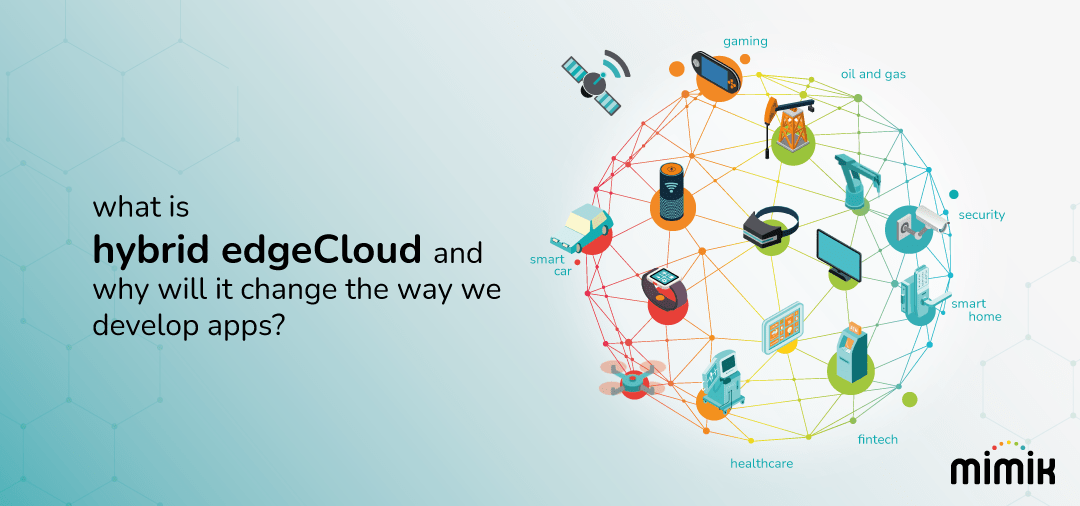
what is hybrid edgeCloud and why will it change the way we develop apps? https://mimik.com/what-is-hybrid-edgecloud-and-why-will-it-change-the-way-we-develop-apps/ Sun, 28 Nov 2021 22:13:31 +0000 https://stg-2x.mimik.com/?p=71981 First generation cloud technology has given users access to storage, files, softwares, and more through devices connected to the Internet, instead of over a hard drive. This same type of cloud technology initially worked through the hosting of siloed apps, where users went to the web to access the information they needed and by doing so got serviced through a central cloud.

The post what is hybrid edgeCloud and why will it change the way we develop apps? first appeared on mimik.

]]>
First generation cloud technology has given users access to storage, files, softwares, and more through devices connected to the Internet, instead of over a hard drive. this same type of cloud technology initially worked through the hosting of siloed apps, where users went to the web to access the information they needed and by doing so got serviced through a central cloud.

the future however is looking brighter as it’s all about a hyperconnected web where apps and devices connect and communicate through a combination of edge devices and servers in the central cloud. at mimik, we believe that the future is about decentralizing the cloud by enabling all computing devices to act as servers to protect our data, minimize usage of energy and other resources to help save our planet.

Enter hybrid edgeCloud computing

like with any technology that is rapidly evolving, cloud technology has also evolved in the face of a more hyper-connected world. changes with future innovations have allowed for an interconnected web where different apps and devices communicate using both edge devices and servers in the central cloud. these ‘edge’ devices can be anything from smartphones, tablets, PCs, smart TVs, game consoles, robots, drones, and AI-based sensors.

an edgeCloud platform allows any computing device to act as a server, letting other devices communicate directly to the application layer, hence developing a hybrid edgeCloud that is larger, faster, cheaper, and with stronger data privacy for its users.

mimik’s disruptive technology essentially is for cloud decentralization — as each edge device gets to act as a server. mimik’s hybrid edgeCloud does not need any hubs or gateways and can leverage the processing power, storage, and memory of all computing devices. the good part about the hybrid edgeCloud is that it runs on any platform be it windows, android, mac os, iOS, linux, or raspbian.

Benefits of edgeCloud technology

  • optimal privacy — you can process sensitive data on local edge devices, eliminating the unnecessary middlemen.
  • lowest costs — reduce hosting and bandwidth costs by maximizing the use of resources on edge devices.
  • lowest latencies — using the shortest-path communications between devices, microservices, and clusters at the edge.
  • rapid app development — developers can utilize the familiar api development framework, languages, and compatibility with container and orchestration tools for native application development.
  • lowest carbon footprint — cut data transfer by upto 70% and improve system-level efficiency.

what does this mean for developers?  developers can take advantage of the benefits in efficiency and processing power, in helping them accelerate their product development while using mimik’s platform. the platform comes with a run-time engine that enables developers to work with global functions in the central cloud while moving processing workloads to different edge devices such as smartphones or TVs.  developers can experience its flexibility as the engine is agnostic to any OS, device, network, or cloud — being non-proprietary, it can work with the already existing standard development tools. mimik also offers ready-to-deploy edge microservices for a wide range of industry verticals. mimik’s platform is free to develop and has a pay-as-you-grow pricing plan, letting you easily scale up.  learn more about mimik’s hybrid edgeCloud mimik is passionate about democratizing the cloud and Internet so that each person can equally benefit, as well as minimize energy use through efficiency to save on our planet’s already limited resources. mimik extends cloud server capability to all computing devices, consumer, and enterprise applications. we do this by making “the cloud” larger, easily scalable, and efficient to meet the needs of an increasingly hyperconnected world. this results in inter-operable apps, savings in time and hosting costs, savings in network bandwidth, reduction in latency, and improved data privacy for users.  to learn more about our technology get in touch with an edgeExpert today : Contact Us.
The post what is hybrid edgeCloud and why will it change the way we develop apps? first appeared on mimik.

]]>